

One year of Mysore-style yoga
October 1st 2018 – October 1st 2019
It’s been 1 year since I started doing yoga every day so I wanted to write something to try and explain the impact it has had. I think in the entire year I’ve been practicing, I have missed maybe a total of 6 or 7 days where I totally didn’t practice at all. When I’m not able to come to the studio, I practice at home or wherever I happen to be. If I’m injured or sick, I do a gentle modified practice.
When I say I do yoga every day, what I’m actually talking about is something called a “Mysore-style” practice. It’s named after the birthplace of yoga, Mysore in India.
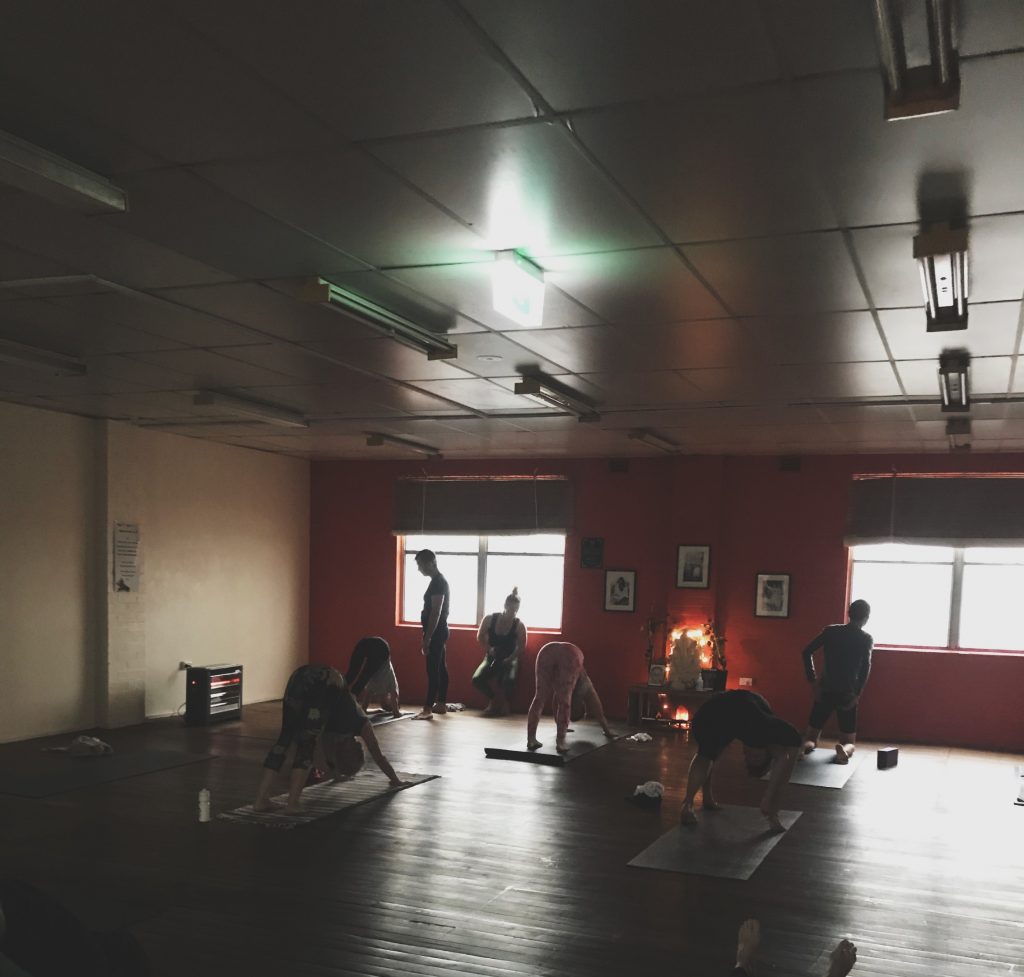
This is basically an open session, supervised by a teacher and assistants. The students/practitioners complete a yoga sequence, each at their own pace. Every one of them has been taught this sequence, pose-by-pose. That means everyone who comes into the room is probably practicing something slightly different, aligned to their own limitations and designed to push them a healthy amount. They are of all kinds. Old, young, overweight, underweight, healthy, unhealthy, pregnant, injured, flexible, and inflexible. Brand new people, and those who have an established practice are there together side by side.
You can rest when you feel it’s needed, you can modify as required and you can finish when you like. Everyone arrives and leaves at different times. It is a highly personalised and intimate setting. It’s also usually practiced in quiet, if not silence. At my studio, doors open at 5:30am, there is also a PM session daily. My practice at the moment probably goes for about 90-minutes to 2 hours per day.
This style of yoga practice is what has allows me to “do yoga every day”. If I had someone yelling poses, and trying to lead a class of 20 people through a random set of movements at the same pace every day, I certainly would not have stuck with a yoga practice this consistently. I don’t know how people do that. In Mysore-style sessions, you get personalised attention from expert teachers, and you’re silently supported by the energy of the room – there is no expectation to perform to anyone else’s standard or wear any expensive clothes.
Mysore style is special.
It requires passion to entertain the idea in the first place. It demands determination and discipline, especially if you do it every day. If you don’t have strength of character before starting Mysore-style, you will either quit, or you will create that strength of character. The first time you show up, you will have no idea what is going on, even if you’ve done yoga before. It’s intimidating and probably seems abnormal, but it’s also magic.
In Ashtanga yoga Mysore, you practice the same sequence of movements daily. Slowly, you add more and more poses until you have all the asanas of the Primary Series to practice. Poses are given to you by the teacher, who watches your progress and adjusts you accordingly. Everybody says this, but only because it’s the truth – it’s not really about the physical pose. It’s about the mental effect of doing the same thing every day and noticing the minute differences in your body and mind each time. It’s about the experience of allowing yourself to hold an ideal without getting tunnel vision, or beating yourself up. It’s about learning to breathe and be still in what is sometimes extreme discomfort. It’s about learning how to fail. It’s about falling on your face in front of a room of people. It’s about learning to move the physical body with integrity, while caring for the emotional and energetic aspects of our beings.
Imagine you have a car. It’s a really fancy one, like ultra-modern futuristic type. It has all these crazy features. It took FOREVER to develop it as a product. It can do some really incredible things, and you’re pretty stoked to have it.
But you’re not sure how it really works. You can sit in the driver’s seat. You press the button that turns on the engine. You know how to move the gearstick to put it into Drive. You know how to accelerate, you know how to break. You know how to drive in a straight line and stop the car. But that’s it. It took you your whole entire life to figure that much out.
You don’t know how the car works. You know that petrol fuels it, but not much more than that. You know how to come to a dead stop, but not about how to hill start or to reverse – park. You can hardly drive on the correct side of the road. You’re not even sure how to turn on the air conditioning. It’s got a lot of fancy buttons and displays inside, but you don’t know what they do and you’re scared you will break the car if you start messing with them. You heard that there are a bunch of cool and different things that people can do with their cars, but you have no idea how. You should be able to drive it through a river and up a mountain, but you don’t know how to change gears. You just hang out in the same places a lot because you’re scared to drive the car very far away. You should be able to go in circles if you want. Do a donut or whatever, drive really fast, or really slow, or through a scenic route. But you can’t even make a left turn. Worse, there’s a pretty shit radio station stuck on the stereo and you don’t know how to turn it off.
This is my analogy for being in the body. This is why we “do yoga”. The ancient science of Hatha Yoga teaches us the fine controls. It teaches us how to change gears, drive through rivers and across mountains. It teaches how to stop and go, slow down and speed up, how to maximise efficiency. It teaches us how to clean, refuel, perform maintenance and fix the broken parts. It teaches how to delicately manoeuvre the vehicle, so that we become the master of the tool. Gradually, we learn what all the buttons do. It teaches us to change the radio station, or turn it off. You realise you can go anywhere and do anything.
The body is your main tool while you are here in this lifetime – you can and should learn how to use it to the full extent of its abilities.
But the most important thing you learn, is that while it is a tool, it is also more than that. You will discover something else.
You will begin through the practice of yoga to have a relationship with the body that is more than that of master and slave. Through practicing in silence with the body and mind every day, you realise that the body is not a slave, or a fancy car. It is a home. It is a friend. It is a partner for every endeavour that you have in the world. And you can’t “make” a partner do anything. You can’t treat a friend with disrespect. You have to care for your home, not punish it. You cannot issue commands to the body. You cannot force it. You must ask.
You must ask – always gently and yet with persistence. Yoga is a process of asking permission.
What do you need? What makes you feel good? What are you able to do for me today? Can you try it again? Maybe next week? Will you go further?
Little by little, the body will respond to this, and gift you with more control. It will gift you with abilities which you never thought possible. All you need for this is consistency, passion and respect.
That’s what I have learned from 1 year of Mysore-style yoga. I think you should try it.
Leave a Reply
You must be logged in to post a comment.